
| |
|
| |
|
|
| |
Fibar for Tracks & Gallops
|
|
| |
|
|
 |
 |
|
| |
Training
Track,
New Jersey |
|
|
| |
|
|
| |
Does
your training program lose ground when
it rains? If
your horses work on any ordinary riding
surface, your entire training program
could go under when it rains. First your
footing could get deep. Sticky. Cuppy.
A perfect setting for a bowed tendon.
Second, a good downpour could leave the
water sitting in puddles on your riding
surface. Finally, the water might rush
off with your dirt cushion, exposing
rocks and leaving your riding surface
thinner and harder with every shower.
And your horses’ bones more and more
vulnerable to injury from shock and concussion.
|
|
| |
|
|
| |
|
|
| |
|
|
| |
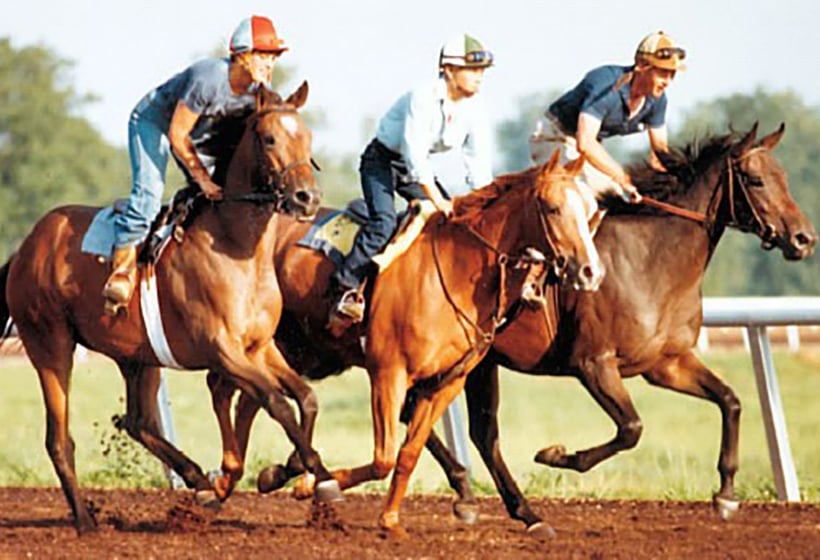
But
if you work your horses on Fibar®,
your training program will go on rain or
shine, wind, sleet or snow. A Fibar riding
surface is resilient and useful in all
kinds of weather. Manufactured from selected
wood fibers and installed over a specially
prepared base that includes FibarFelt®,
a unique geotextile blanket that draws moisture
down and drains it away.
That’s why Fibar is the footing
of choice for performance-oriented owners
and trainers who want to keep their training
tracks, gallops and riding rings in full
time operation. They know with horses you’ll
win some and you’ll lose some, but
with Fibar, you’ll never be rained
out.
To talk with a Fibar expert about your
tracks and gallops, contact us today. |
|
| |
|
|
| |

|
|
| |
|
|
| |
|
|
| |
|
|
| |
|
|
| |
|
|
| |
TRACKS INSTALLATION
| Fully-Percolating System |
|
| |
|
|
| |
 |
|
This
design has a blanket of clean, crushed,
rain rock underneath the entire track.
This system is used with FibarFelt® fabric to
separate the stone from both the sub-base
and the cushion. The cushion can be made
up of Fibar® or of sand and Fibar. |
|
|
| |
|
|
| |
|
|
| |
GALLOPS
INSTALLATION | Fully-Percolating System |
|
| |
|
|
| |
 |
|
This
installation method is similar in all
respects to that used for Tracks (see
above). |
| |
|
|
| |
|
|
|
|
| |
DOUBLE FELT INSTALLATION
METHOD FOR TRACKS & GALLOPS |
|
| |
|
|
| |
- The site must be surveyed
with a transit so that the crown
of fall is accurately excavated.
- Remove vegetation
and top soil from track/gallop
and surrounding area. Grade base 2% cross-slope.
Compact to 95% modified Proctor or
better.
- Incorporate swales
and ditches on both sides of
the track to keep migrating surface water
away from the track.
- A. The
optimal drainage design is to build the
entire structure, stone and Fibar, above
grade. Allow an additional 2 feet to
the inside of the track and carry the stone
and FibarFelt® onto this apron. The Fibar
would be contained by a 2" x
8" pressure-treated board fixed
to the rail and placed on top of
the stone. This will provide a continuous
weeper giving maximum drainage.
B. If this is not possible,
a design similar to the cross section
in the Technical Manual (available
on request) should be used with a
collector pipe running around the
perimeter of track. This pipe and
French drain should be alternately
placed on the infield side of the
running rail.
- Install rail.
To insure proper finish height, allow
an extra 6" for stone
and 12" for Fibar wood fiber.
- Roll out FibarFelt
material 12 to 18 inches, overlapping
at all seams. Extend FibarFelt material
18" outside
rail line. Slit FibarFelt material
with scissors or razor knife
to fit around posts.
- Bring in six
(6) inches of 1" to
2" open aggregate drainage stone
(#57) and roll. Operator should not
travel on the FibarFelt.
- Cover stone
drainage bed with FibarFelt, overlapping
12" to 18" at
all seams.
- To retain Fibar,
affix a 2" x
8" pressure-treated board to
the base of the rail (boards to be
placed on top of the stone).
- Finish building the rail.
- Spread Fibar, back-dumping
off the Fibar already in place. Take care
when traveling on the FibarFelt not to
make sharp turns or sudden stops and starts.
Since Fibar wood fiber is a naturally fibrous
material, there will be a variation in
the amount the material will compact and
settle when spread. As a general rule,
if we deliver 12" loosely laid, allow
for about 30% compaction giving a finished
depth of about 8". This settling
and knitting together is what makes
Fibar wood fiber work!
- After rough
grading, the Fibar surface should be
watered thoroughly and smooth-harrowed
using a 6’ x 10’ chain-link
drag.
IMPORTANT |
In accordance
with standard design and
construction practices, The
Fibar Group, LLC recommends
using the services of a qualified
engineer or architect, who
is familiar with local soil
and climate conditions, to
evaluate and interpret the
above guidelines. Prior
to delivery of materials
such as crushed stone screenings,
sand, etc., request a gradation
analysis, which your engineer
can interpret for you.
|
|
NOTE: Site
visits are available where economically
feasible. A fee plus travel expenses may
be requested.
DISCLAIMER
THE ABOVE TECHNICAL ADVICE IS GIVEN GRATIS AND THE
FIBAR GROUP, LLC ASSUMES NO OBLIGATION OR LIABILITY
FOR THE ADVICE OR ASSISTANCE GIVEN OR RESULTS OBTAINED,
ALL SUCH ADVICE OR ASSISTANCE BEING GIVEN AND
ACCEPTED AT BUYER’S RISK. MAINTENANCE
- Keep Fibar damp throughout. If not,
it will break down prematurely.
- Harrow regularly using a Brillion
Pulvi-Mulcher or similar machine.
- The surface
will improve with time. In the first
few weeks the wood fiber will be gradually
knitting together – rain,
watering and smooth harrowing will
all help the process.
- Depending on usage, you should plan
to top off the surface periodically
(anywhere from 2 to 3 years).
- More about maintaining
your Fibar surface.
TOP
OF PAGE
|
|
| |
|
|
|