

EWF Maintenance
Stay educated on maintaining your surface.
Fibar Maintenance Documents
Engineered Wood Fiber Maintenance Instructions
Learn about the maintenance instructions for your surface.
Visual Inspection
Look for debris-especially stones, broken glass or other foreign objects and remove them. Check to make sure that the level or depth of the Fibar® Engineered Wood Fiber surface doesn't fall below the original design depth. The legs of the equipment should have been marked with a bold horizontal mark showing the design depth when originally installed. If they are not, take the time to mark the legs with an indelible marker at the original design depth, measuring from the bottom of the Fibar surface. This will allow you to readily see when Fibar needs to be redistributed or topped off to maintain proper original design depth.
If the equipment was not marked, or you choose not to mark it, the surface must be checked at a number of points using a long-handled screwdriver marked in inches to determine the actual depth. If the actual depth is below the original design depth, redistribution and/or top-off is needed. See the Raking section of our Maintenance Document, and top off if the depth of the Fibar is below the original design depth. Inspect the surface daily.
FibarMat Wear Mats
To help make your playground accessible in high use areas, FibarMat wear mats must be installed under all swings, tire swings, and slide exits. They should also be installed at other excessive wear areas, including sliding poles. The preferred method is to place the mats on top of the Fibar Engineered Wood Fiber.
To help ensure compliance with ADA federal accessibility standards, FibarMat wear mats should be installed under all swings.
FibarSystem Maintenance
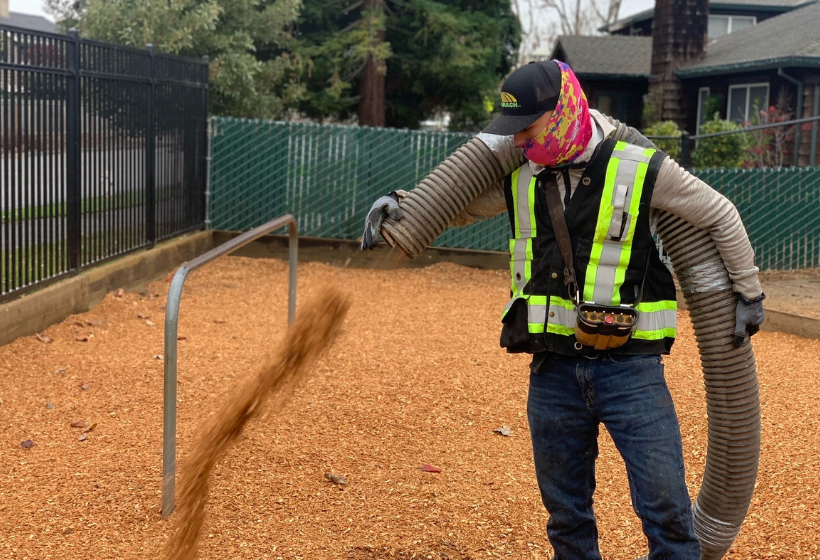
Experience has shown that installations typically require top-offs after three (3) years of use (on some playgrounds, maybe sooner). Top-Offs can sometimes be scheduled with other deliveries to minimize the freight cost. See first tab, "Visual Inspection," for more information.
We also offer Top-Off deliveries that are installed by one of our Express Blower Trucks - We call it FibarQuick.
Raking
Wear areas, such as under swings or at slide endings, should be raked level and maintained at the original design depth as measured from the bottom of the Fibar surfacing enclosure to the top of the Fibar surface. See Tab 1, Visual Inspection, regarding the use of the marks on the legs of the equipment to readily determine the relationship between the actual depth and the original design depth. When a Fibar Engineered Wood Fiber installation is close enough to a sand pit that sand gets tracked into the Fibar surface, this could adversely change the impact attenuation characteristics of the Fibar Engineered Wood Fiber.
Accessibility
Depending on weather and usage, a Fibar surface will compact to provide access for mobility devices within two to six weeks of installation.
Add a Fibar Wheelchair Access Ramp for accessible entrance onto the playground surface. Crafted from tough, high-density polyethylene. Won't fade, splinter, or crack. Wide enough for motorized wheelchairs. The easiest way for kids in wheelchairs to access an above-ground playground. ADA compliant.
Drainage
Check the performance of the drain system by ensuring that water is flowing from a drain system outflow pipe immediately after rain. Also, make sure there is no standing water on the playground surface. It is important to have a functioning drainage system to improve Fibar’s life expectancy and the resilience of the surfacing.
Conditions could occur that might cause weed growth. You can remedy this situation by use of a safe weed killer (call your local Cooperative Extensions office for recommendation) or pull out weeds by hand.
Incorrect Installation or Maintenance
Failure to install all the materials delivered, failure to maintain the depth of the Fibar Engineered Wood Fiber at the original design depth, failure to use FibarMat wear mats at slide exits, under all swings and tire swings (except enclosed or tot swings), other wear areas (a wear area is any area in the playground where the surface depth falls below the original design depth for the playground surface), use of the Fibar System and/or materials with others not provided by The Fibar Group, LLC, abnormal use, lack of proper maintenance, or vandalism can result in serious injury or death. Be aware that no playground surface can prevent all accidents or injuries.
Winter Conditions
Should there be moisture retention in the Fibar Engineered Wood Fiber, it will freeze when the temperature drops below the freezing mark. Please check your surface frequently in winter weather. When the surface is frozen, the impact attenuation properties of Fibar are lost and for this reason, the play area should not be used.
Reread the Installation and Maintenance Instructions periodically
If at any time you are concerned about the surface and its performance, please contact us by emailing info@fibar.com or call us at 1-800-342-2721 or (914) 273-8770.
Project Calculator
Estimate the amount of EWF you need for your project.
Need maintenance for your surfacing?
Click here for a quote on maintenance.